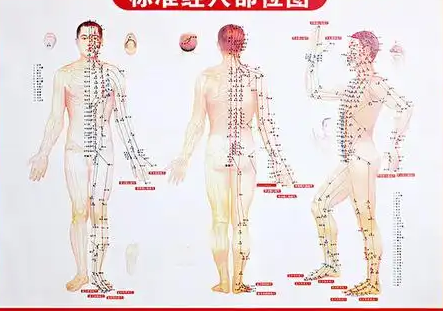
Human Yin-Yang Spatial Geometric Symmetry Model
The Yin-Yang model not only governs temporal fluctuations horizontally; it also shapes spatial structure vertically. At the micro-spatial scale of the human body, the ancients established an orderly geometric method of division: the human Yin-Yang spatial geometric symmetry model. When the entire body is treated as a Yin-Yang system, its most important geometric boundary and point of symmetry is the navel, the Shenque acupoint. The core first-principles idea is topological partitioning with respect to a geometric center. A tree offers an analogy: the depth of its roots is not necessarily less than the height of the tree above ground. A tree therefore also lives at the intersection of the qi of Heaven and Earth. In the human body, if the navel is taken as the horizontal axis of a geometric plane, a regular Yin-Yang spatial distribution appears: upper is Yang and lower is Yin; front (abdomen) is Yin and back is Yang; lateral is Yang and medial is Yin. Together these form a three-dimensional topological coordinate system. What appears to us as the place where a tree meets the ground can, by analogy, be regarded as the tree’s “navel.” Within the classical framework, this geometric distribution allows the principle of superposition to be used in estimating the Yin-Yang attribute of any point on the body. For example, a point that is in the upper, posterior, and lateral region can be described as Yang within Yang within Yang.