

Bodily Form and Treating Form through Form
Beyond nature and flavor, the bodily form of a medicine is equally important. Here “body” includes seeds, vines, bark, kernels, branches, roots, minerals, and other forms and textures. These are not decorative information; they were important clues by which the ancients judged the direction and bodily location of a medicine’s action.
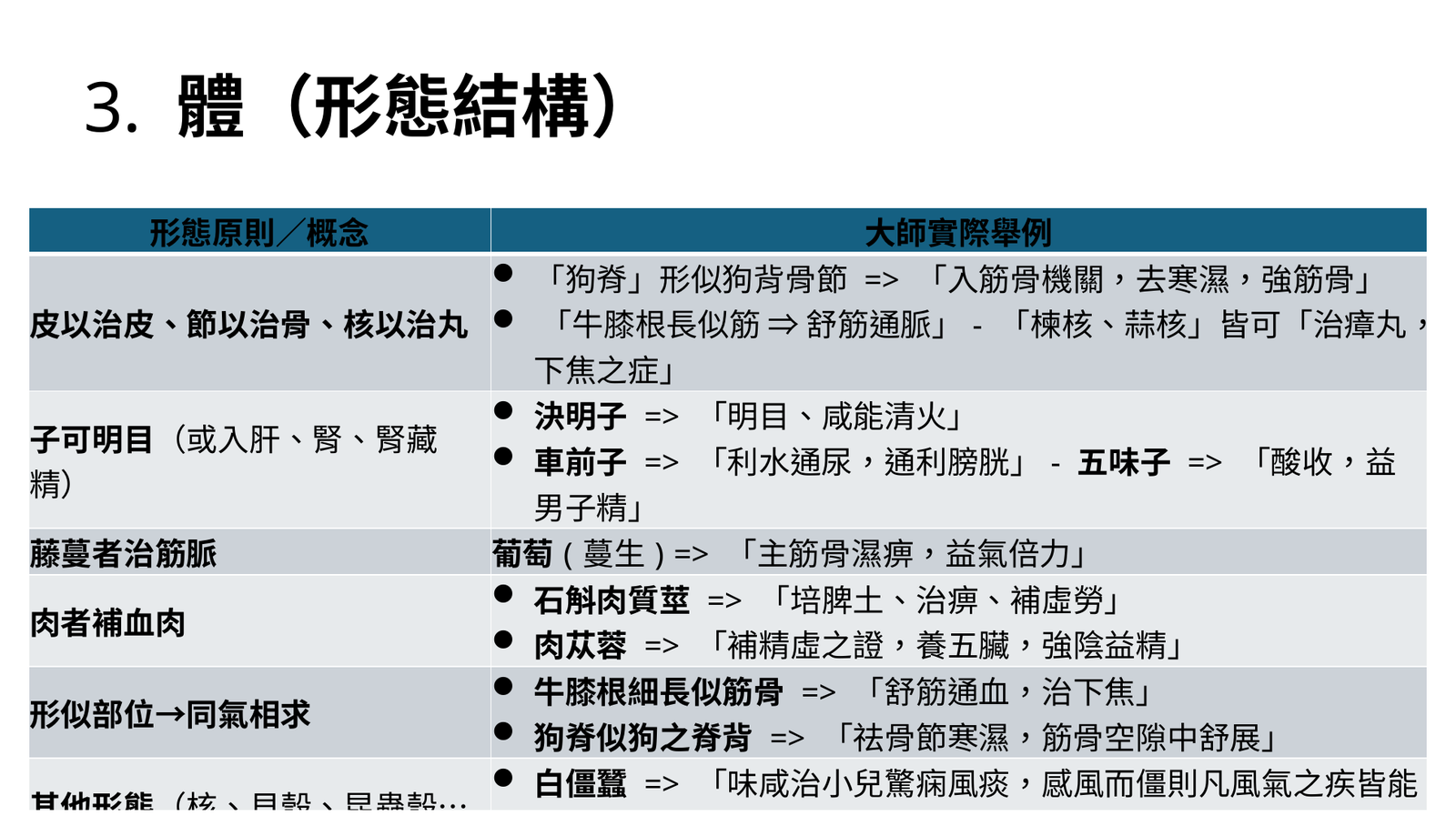
The core principle is close to observing qi through form. Seed medicines tend to store essence internally and have rounded, condensed morphology; in some formulas they therefore form image-correspondences with the eyeball, essence orifices, rounded nodules, and similar structures. Bark can treat the skin; vines can open the network vessels, spread, and guide qi; branches resemble transport channels and are often used to understand communication of qi between upper and lower, inner and outer.
We mention Nine-Seed Rehmannia Pill for cataracts to illustrate the image-correspondence between “seeds” and a round structure such as the eyeball. We also note that kudzu is a vine and can be understood as drawing Yin qi upward from below and opening the Taiyang channels. These are presented not as superstitious analogies but as the ancient use of morphology as a clue to qi-transformational function.