

An Inner Canon Symptom Rule Base and Explaining One Classic through Another
The greatest difficulty in decoding the Shennong Bencao Jing is not merely its brevity, but the need for a large symptom-and-disease rule base from the Inner Canon. We note that dozens of chapters in the Suwen and Lingshu contain causal descriptions linking symptoms and disease. These are the armory of rules the ancients could use to interpret medicinal effects.
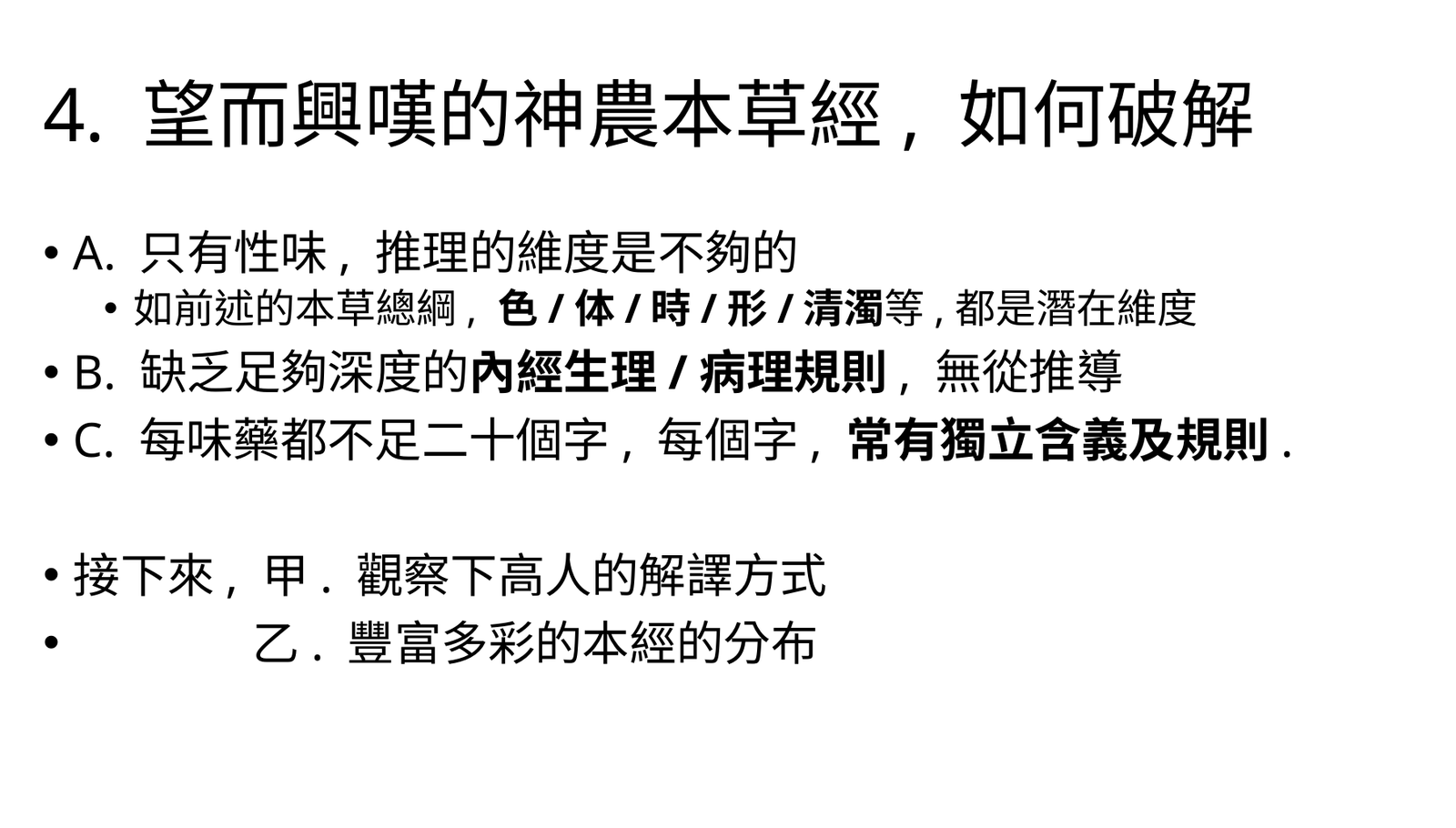
The principle of explaining one classic through another is not to use arbitrary later imagination, but to cross-check passages against physiological, pathological, and qi-transformational rules already present within the classics themselves. For example, the “Treatise on Cough” unfolds cough of the five zang and six fu separately, creating rules from organ to symptom. Such rules can be extracted as causal statements and then used to interpret materia-medica passages.
We estimate that more than 1,900 symptomatological or disease rules can be organized from the Inner Canon. They may not cover every clinical phenomenon, but they are enough to provide a starting point for interpreting each medicine’s twenty-character description in the Shennong Bencao Jing. Without these rules, many indications remain little more than material for memorization.