

Matrix Vectors of the Overcoming and Supporting Positions in the Spatial Model
To enable the five-flavor spatial model to be precisely encoded and computed in modern AI systems, the ancient relations of generation and overcoming must be transformed into clear mathematical-geometric vectors. The spatial model contains two core computational operators: the Overcoming Operator and the Supporting Operator. This geometric operator architecture provides an exceptionally concise mathematical framework for understanding the enormous and fragmented body of ancient treatment rules and classical-formula combinations.
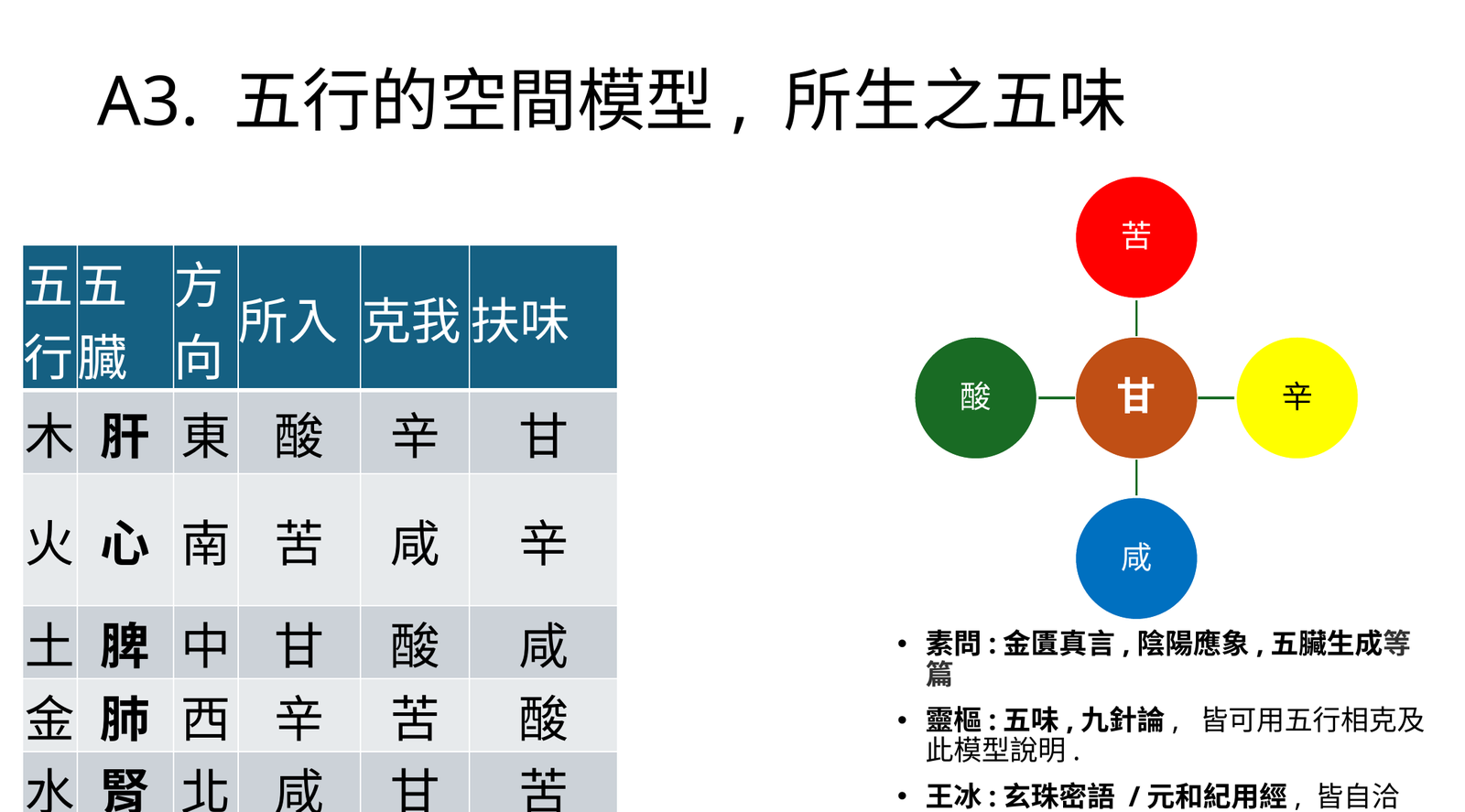
Overcoming-position function: the spatial Five-Entrance flavor corresponding to the position of the phase that “overcomes me.” For example, Metal overcomes Wood; Metal occupies the West and corresponds to pungent flavor. Pungent is therefore the overcoming-position vector in the spatial coordinates of Wood (the Liver).
Supporting-position function: the flavor that can generate and support a phase when that phase has been severely overcome and the system begins to collapse. For example, Wood overcomes Earth. When Earth is endangered by being overcome, it requires generative support; at this point the supporting-position vector corresponds to the supplementing flavor associated with the Five-Phase property of Wood, the overcoming party—sweet.
In the Huangdi Neijing, passages involving direction and the spatial Five Entrances can, according to this model, be brought under these two geometric vectors. When Wood, Fire, Earth, Metal, and Water are unfolded in sequence, their spatial overcoming-position flavors form a precise geometric cycle of sour, bitter, sweet, pungent, and salty. By converting generation and overcoming into the mathematical coding of “overcoming position” and “supporting position,” apparently arbitrary treatment instructions—such as which flavor should support an organ when it is overcome—become clear formulas that can be entered into a computer. This is also a key step in the claim that classical formulas arise not merely from experience, but from formal logical derivation.