

The Therapeutic-Flavor Structure of Six-Qi Victory in the Sitian Position
In the “Great Treatise on the Utmost Truth,” the treatment rules for “the qi of Sitian, when the six excesses prevail” appear on the surface to pair each of the Six Qi with a set of five flavors. After formal logical testing, however, they can be read not as an arbitrary lookup table but as a structure composed of one underlying rule and three directional corrections.
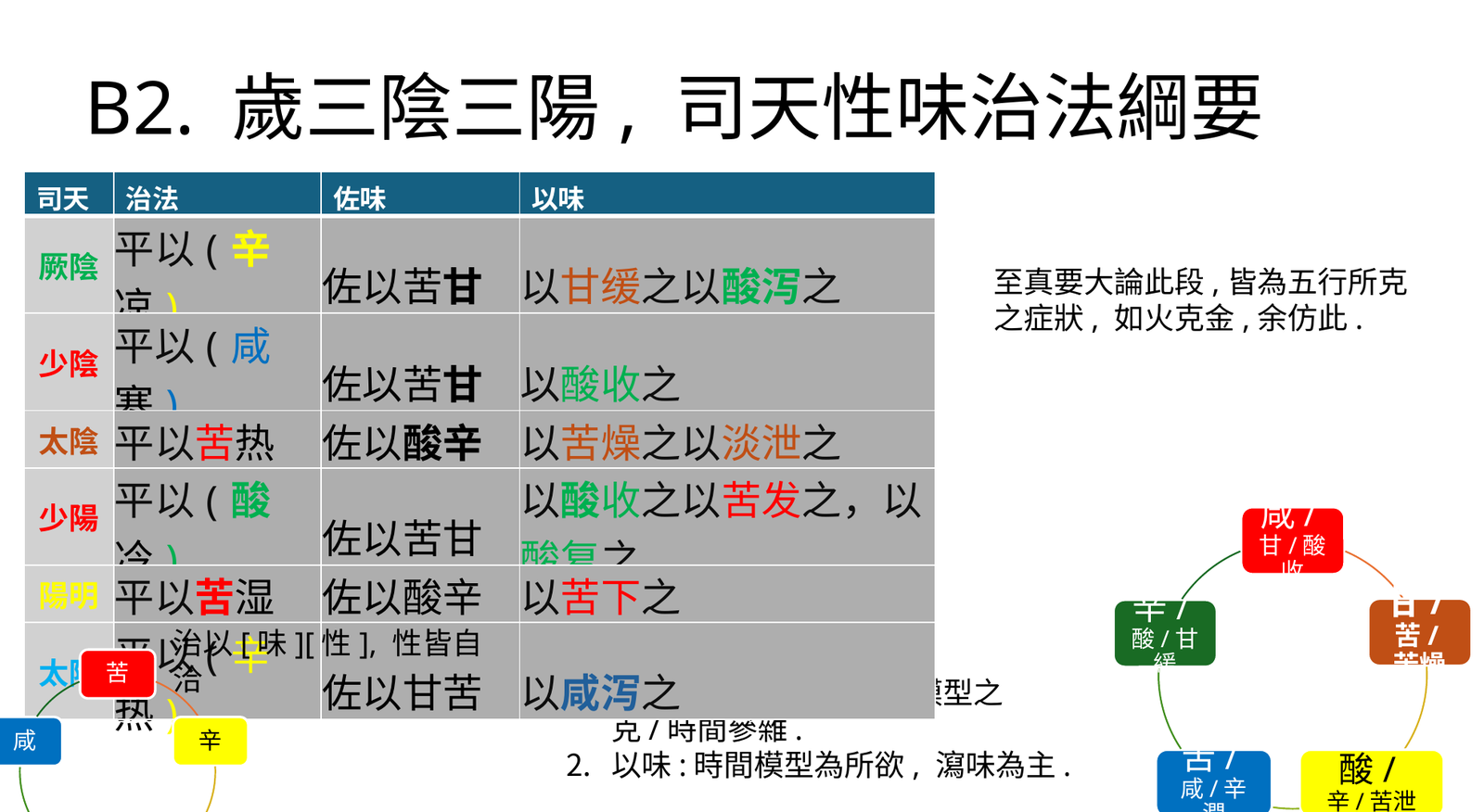
The most basic rule uses Five-Phase overcoming as the first criterion: when Wind-Wood is excessive, use the Metal flavor pungent to level it; when Heat-Fire is excessive, use the Water flavor salty to level it; when Dryness-Metal is excessive, use the Fire flavor bitter to level it. This suggests that the first flavor in the phrase “level it with such-and-such flavor” is, in principle, the intrinsic flavor of the phase capable of overcoming the phase to which the excessive qi belongs. Formal testing shows that simple Five-Phase overcoming alone explains eight of twelve cells, already a strong underlying rule.
But the Inner Canon treatment method is not merely abstract Five-Phase overcoming. When the main contradiction is dampness, the text in two places does not use sour—the Wood flavor that overcomes Earth—but directly uses bitter to dry. This means that when dampness is excessive, the real target is not abstract excess of Earth qi, but excessive moisture itself. The rule “bitter dryness overcomes dampness” therefore overrides ordinary Five-Phase overcoming. Adding this rule raises the model from 8/12 to 10/12.
The remaining two exceptions both occur in the Sitian position: Sitian Fire uses sour rather than salty, while Sitian Cold uses pungent rather than sweet. These are not arbitrary changes of flavor; the pathological direction changes because the qi occupies the upper position. With Fire in Sitian, the problem is not only excessive heat, but Fire qi dispersing and escaping from above. The text repeatedly says “gather it with sour” and “restore it with sour,” so the therapeutic focus shifts from “Water overcomes Fire” to “sour gathers dispersed Fire.” When Cold occupies Sitian, the problem is not simply excessive Cold-Water, but upper-level cold closure and closure of the exterior, so treatment shifts from “Earth controls Water” to “pungent disperses cold closure.”
The most concise conclusion is therefore: Five-Phase overcoming supplies the underlying rule; dampness is treated directly through bitter drying; Sitian Fire uses sour gathering to address upward Fire dispersal; and Sitian Cold uses pungent dispersal to address upper-level cold closure. With these corrections, the minimal formula described here reproduces all twelve Sitian and Zaiquan therapeutic-flavor cells: simple Five-Phase overcoming gives 8/12, direct treatment of dampness raises it to 10/12, and directional correction for the Sitian position reaches 12/12.
The result suggests that the five-flavor treatment system in the “Great Treatise on the Utmost Truth” is not a simple “one qi, one flavor” mapping, but a multidimensional qi-transformation control system. The choice of therapeutic flavor is influenced simultaneously by Five-Phase balancing, ascent and descent, inward and outward movement, dispersal and gathering, opening and closing, dryness and dampness, consolidation and softening, and urgency and relaxation. The five flavors are therefore not one-dimensional directions of ascent and descent, but action vectors capable of correcting the dominant pathological coordinate in the opposite direction.
The true value of this Sitian Six-Qi treatment group is thus not memorizing a table of “wind–pungent, heat–salty, damp–bitter, fire–sour, dryness–bitter, cold–pungent,” but seeing the hierarchy of rules behind it: first use the Five Phases to determine the basic overcoming relation, then allow the specific property of the qi and its directional position to determine whether that default is overridden. This is a key step in making ancient Chinese medical treatment rules formalizable, testable, and compressible into computable rules.