

The Treatment Structure of the Restoration of the Six Qi
The “Great Treatise on the Utmost Truth” passages on the restoration of the Six Qi do not describe a qi simply appearing again. They describe the principle “where there is victory, there is restoration”: after a qi becomes excessively dominant in an earlier phase, a retaliatory qi capable of constraining it activates in a later phase to restore systemic balance. If the restorative qi unfolds harmoniously, imbalance can return to equilibrium; if it erupts too violently, the restorative qi itself becomes a new excess.
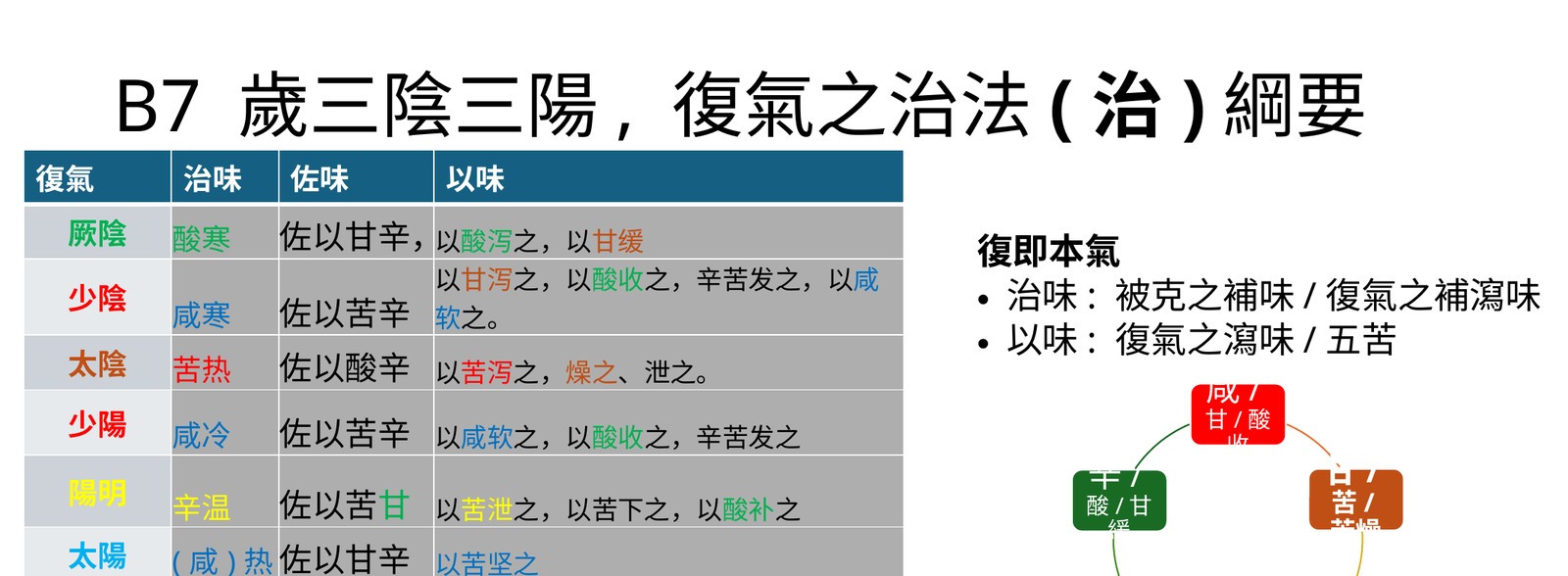
Formal testing yields an important conclusion: the first therapeutic flavor in the restoration group usually does not take the flavor that overcomes the restorative qi. Instead, it takes the draining flavor of the restorative qi itself. Because restoration is already a compensatory rebound, the therapeutic priority is not to support it but to prevent it from rebounding too far. Jueyin Wood restoration uses sour, Taiyin Damp-Earth restoration uses bitter, Yangming Dryness-Metal restoration uses pungent, and Taiyang Cold-Water restoration uses salty; all fit the rule “use the restorative qi’s own draining flavor.”
The two Fire restorations—Shaoyin and Shaoyang—form exceptions. Under the general “drain the restorative qi” rule, Fire restoration should use sweet. The original text instead uses salty-cold or salty-cool. This indicates that when Fire itself rebounds as restorative qi, the central pathology is no longer ordinary excessive compensation but Fire-Heat itself becoming too strong, requiring direct control by the Water flavor salty together with cold/cool thermal nature. Thus the two Fire restorations switch to salty-cold / salty-cool as a direct Water-controls-Fire treatment.
The first therapeutic flavor can therefore be compressed as follows:
General restorative qi: restorative qi arises later and counter-controls the preceding victory → if restoration becomes excessive, use the restorative qi’s own draining flavor
Shaoyin / Shaoyang Fire restoration: Fire rebound becomes excessive → directly control Fire with salty-cold / salty-cool
This also accords with the spirit of the original line, “When qi restores, harmonize what is harmonious; seize what is violent.” Restorative qi is not something that must always be supplemented, nor should it simply be allowed to recover unchecked. When restoration becomes violent, it becomes the object that must itself be seized, drained, and constrained again.
The assisting flavors—sets such as “assist with sweet and pungent,” “bitter and pungent,” “sour and pungent,” and “bitter and sweet”—should not be split into fixed second and third flavors, but treated as sets. Their role is multi-target correction: they must cooperate with the first therapeutic flavor in handling the restorative qi, prevent treatment from becoming too one-sided, and adjust urgency/relaxation, gathering/dispersal, dryness/dampness, thermal properties, and ascent/descent/inward/outward movement. Formal testing likewise shows that the assisting layer cannot be completely generated by a single overcoming formula and must retain treatment class and qi-transformation context.
The tail rules make the operational nature of Inner Canon treatment especially clear. Phrases such as “drain it with sour,” “relax it with sweet,” “gather it with sour,” “effuse it with pungent and bitter,” “soften it with salty,” “discharge it with bitter,” “direct it downward with bitter,” “supplement it with sour,” and “consolidate it with bitter” are not scattered additions; they are explicit flavor × functional operators. Formalized this way, sour is responsible for gathering and restoration, sweet for relaxing, bitter for descending, drying, discharging, and consolidating, salty for softening, and pungent-bitter together can be used for effusion and dispersal.
The final conclusion is therefore: restorative qi is a compensatory rebound after victory; general restorative qi is restrained with its own draining flavor when rebound becomes excessive, while the two Fire restorations use salty-cold/salty-cool to control Fire directly; assisting-flavor sets and tail operators then complete fine-grained operations of relaxing, gathering, effusing, discharging, descending, supplementing, consolidating, and softening. The real value lies not in memorizing six flavor prescriptions, but in recognizing the Inner Canon’s fine control logic for rebound imbalance.