

General Rule for Choosing the Spacetime Model of Heavenly Qi and Earthly Qi
After working through dozens of treatment matrices and hundreds of data-rich passages in the “Great Treatise on the Utmost Truth” and the “Great Discourse on the Regular Order of the Six Origins,” this article extracts what it regards as the most important governing conclusion—one intended to save years of detours. It is the highest-level rule for model selection in the classical-formula section of the Study of Heaven and Humanity: “use the temporal model for heavenly qi; use the spatial model for earthly qi.”
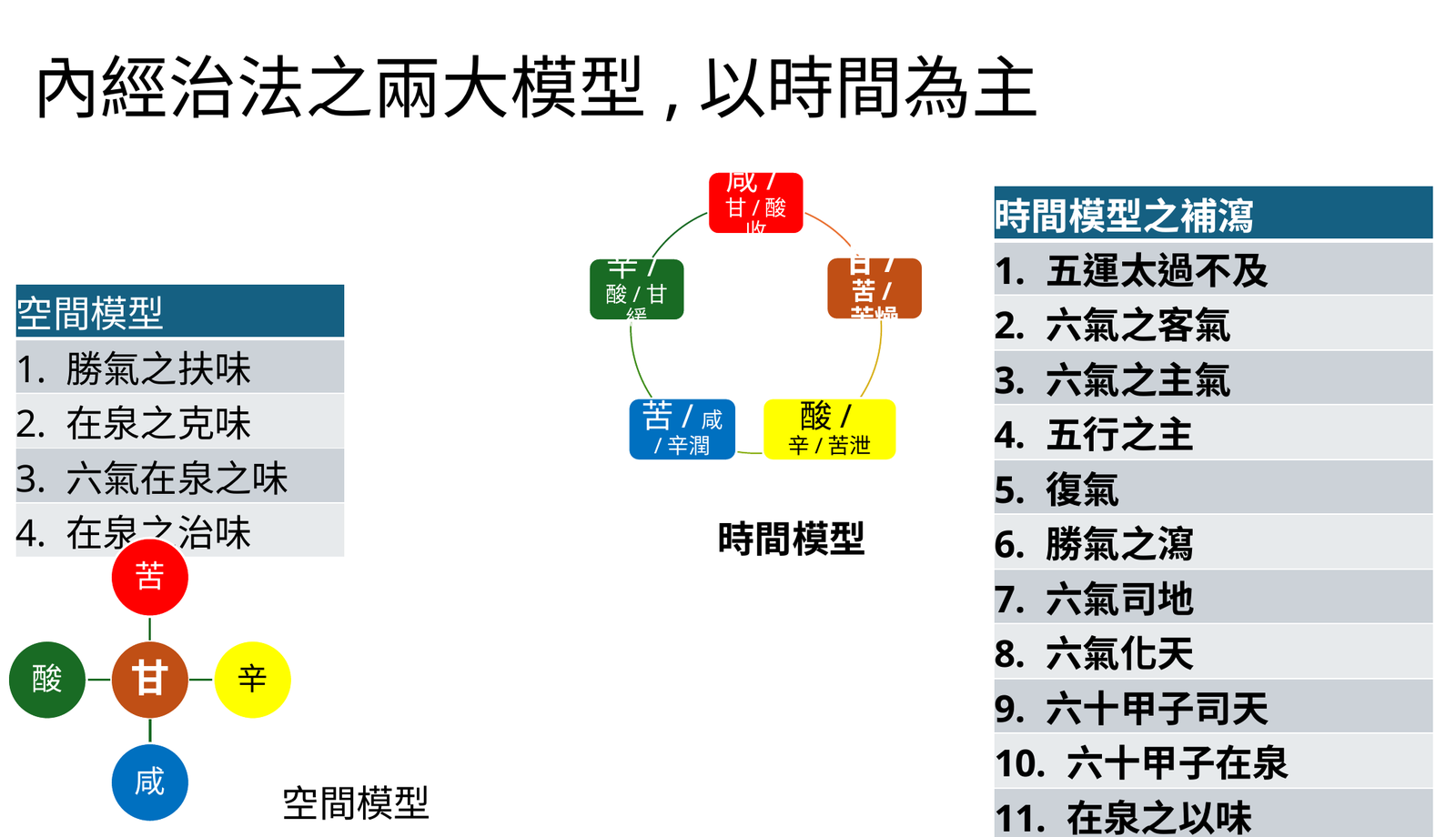
Heavenly qi (Heavenly Stems / temporal model): Whenever imbalance is dominated by high-altitude environment, cosmic-radiation bands, and dynamic cyclical temporal variables associated with Sitian or “transformation in Heaven,” the article treats the energy as being in a wave-like state. Treatment should therefore predominantly use the supplementing and draining flavors of the ten-Heavenly-Stem temporal model centered on the “Discourse on How the Qi of the Zang Conforms to the Seasons.”
Earthly qi (Earthly Branches / spatial model): Whenever imbalance is dominated by Zaiquan, land phenology, geographical geometry and direction, or the material impedance of the physical crust, the article treats the energy as having entered a more material state. Treatment should therefore shift strongly toward the spatial five-flavor model centered on “Earth occupying the center” and its vectors of overcoming antagonism.
The article argues that many researchers fail to understand Five Movements and Six Qi treatment because they try to force the entire Inner Canon into a single set of familiar spatial overcoming rules. The model then fails when they reach Sitian treatments and becomes puzzling again at Zaiquan. Once this general rule of separated spacetime treatment is adopted—view heavenly qi as temporal fluctuation and earthly qi as spatial-geometric overcoming—the two-thousand-year-old text is presented as becoming a much clearer system of equations.