

The Principle of Symbolic Energy Resonance
The ancients understood the importance of matter and were not merely speaking abstractly about qi or energy. Yet the principle that energy is the cause and material change is the effect was, within this framework, not to be shaken. In Chinese medical texts, we often see symbols such as Wood, Fire, Earth, Metal, and Water, or Shaoyin, Taiyin, and Shaoyang, simultaneously mapped to music, directions, tastes, the five zang organs, and even different animal classifications. Modern readers often criticize such correspondences as arbitrary associations. Yet behind them lies a much deeper line of reasoning: when things of different kinds, or things located at different spatial or temporal scales, possess similar energetic qualities and can interact with one another, the ancients chose to express them using the same symbol.
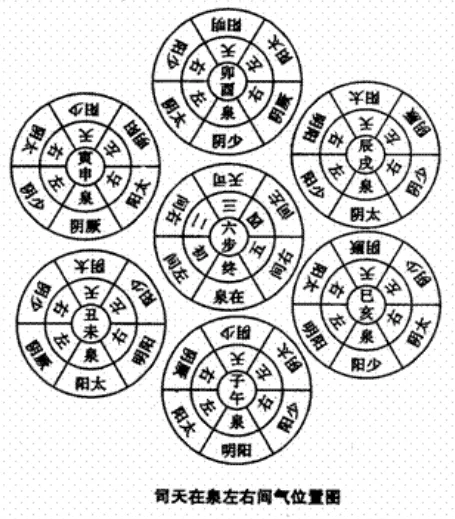
Thus, in ancient Chinese medicine, the principle of cross-scale energy resonance is used repeatedly in the Huangdi Neijing. A symbol is not an empty label; it is a “proxy” for a particular energetic frequency and quality. In modern scientific language, this is comparable to the principle of wave resonance. So long as substances or phenomena share the same wave characteristics on an invisible energetic dimension, they can influence and intermingle with one another. Symbolization was the system designed by the ancients to make such cross-scale resonance easier to calculate.