

Heaven-Earth Yin-Yang Spatial Model
When we enlarge the spatial scale from the microscopic human body to the widest macrocosmic view, we arrive at the Heaven-Earth Yin-Yang spatial model. Many people assume that the ancient image of “round Heaven and square Earth” was a naïve cosmology. Here, however, the phrase is interpreted as referring to the geometry of the atmospheric resonant cavity in which living things exist; another ancient work, the Zhoubi Suanjing, is cited as specifically defining the dimensions associated with “round Heaven and square Earth.”
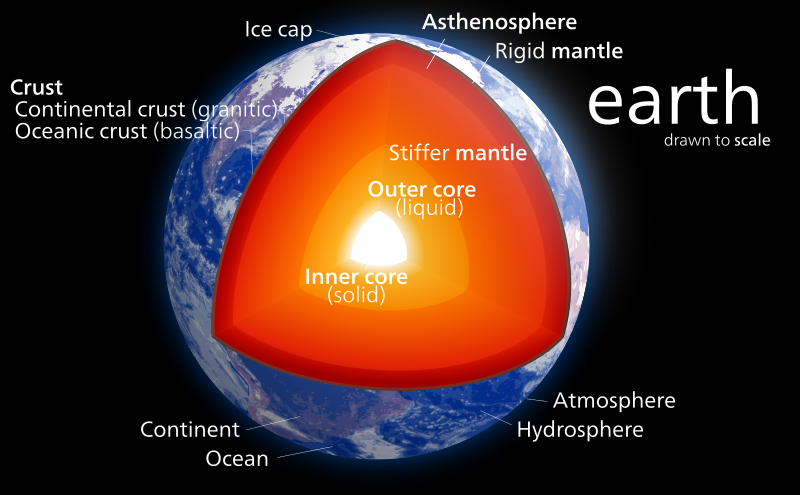
The core first-principles idea is a spherical qi-transformation structure in which Yang lies outside, Yin lies within, and Heaven envelops Earth. In macroscopic geometry, Heaven and Earth are not simply flat layers above and below one another, but inner and outer layers of a sphere. The great envelope of dense airflow and electromagnetic fields surrounding the Earth is described as heavenly qi (Yang), while the hot molten layers and core energy within the Earth’s crust, rising upward, are described as earthly qi (Yin). Together they form a closed spatial model of “Yang enclosing Yin.” A striking dialogue appears in the “Great Treatise on the Regular Course of the Five Movements” in the Huangdi Neijing: Suwen. Qibo states: “The Earth is beneath human beings, yet is itself in the midst of the Great Void,” and proceeds to describe a macroscopic view in which Heaven surrounds Earth and the atmosphere supports it. In this interpretation, the ancients had already recognized that the Earth hangs within the greater void and is situated between the atmosphere above and the thermal energy of the crust below. This is then used to explain the holographic correspondence in the human spatial model in which “the interior is Yin and the exterior is Yang”: the human body is treated as a microscopic holographic projection of the Earth’s spatial structure.