

Partitioning Model of the Twenty-Four Solar Terms
Among the models of ancient Chinese medicine is a system familiar from everyday life but often treated merely as an agricultural calendar: the twenty-four solar terms. Here, the twenty-four solar terms are interpreted as a first-order subdivision of the Three Yin and Three Yang series of time models. One way to distinguish these Chinese medical models, in this account, is to ask whether their numerical structure is based on multiples of five or six. Over the Earth’s annual revolution, the region of most direct solar irradiation shifts back and forth between the Tropic of Cancer and the Tropic of Capricorn. This scanning process is divided into twenty-four segments, producing the twenty-four solar terms. It can also be understood as dividing the Earth’s position on the ecliptic into phase intervals of 15 degrees.
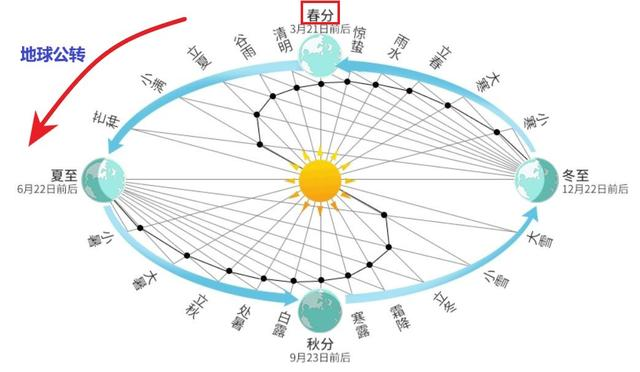
The ancients further subdivided each original sixty-day host-qi period into four, yielding four fifteen-day solar terms and thus twenty-four terms in total. The four most important physical nodes are compared here with concepts from modern calculus: the winter and summer solstices correspond to maximum and minimum points where the first derivative, or slope, of the energy curve is zero; the spring and autumn equinoxes correspond to inflection points, where the second derivative is zero.