

Choosing among Physicians and the Criterion of Classical Self-Consistency
The final question-and-answer discussion returns to a practical problem: when different physicians disagree about the same medicinal substance, how should one choose among them? The answer is not to follow whoever is more famous, but to examine whether the reasoning is concise, self-consistent, traceable to the classics, and clinically grounded.
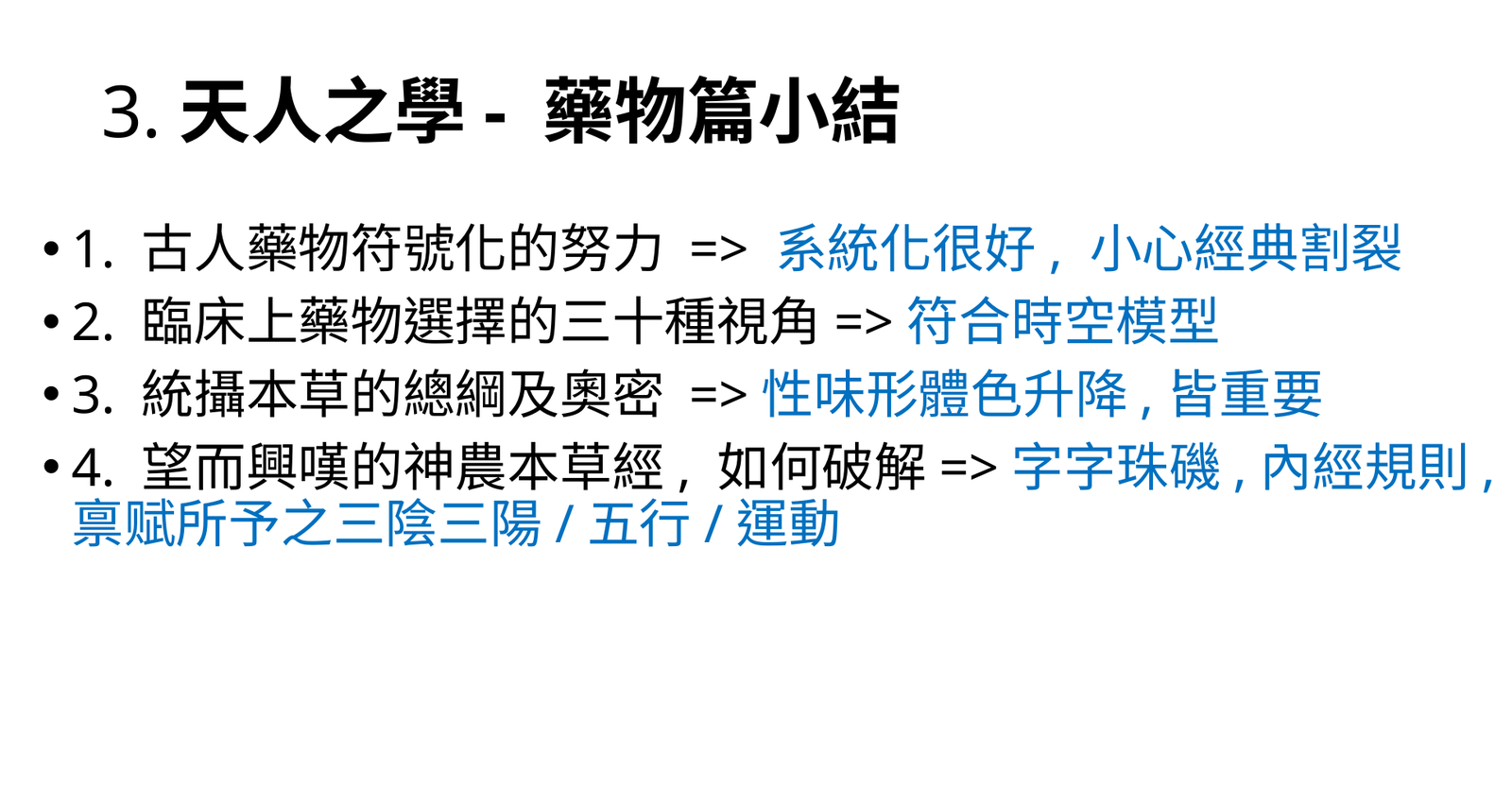
Three criteria can be used. First, can the essence be explained with a small amount of language? If something that should take one or two sentences still remains unclear after ten, understanding may not be deep enough. Second, is the work self-consistent from beginning to end? If hundreds of pages frequently contradict one another, the system is insufficiently coherent. Third, are the rules used for clinical derivation drawn from classics such as the Inner Canon and Shanghan Zabing Lun, rather than being invented at will?
We also discuss statistics of the five flavors: in the Shennong Bencao Jing, medicines assigned two or more flavors are relatively rare. This may suggest that ancient drug selection valued relatively orthogonal coverage by each medicine. In formula composition, each drug ideally plays a distinct role like the X, Y, and Z axes, avoiding excessive overlap of functional ranges.