

The Secret of the Sixteen-Character Dietary Formula and the Principle That Material Formation Determines Flavor
The dietary-therapy system of Chinese medicine is vast, yet the underlying logic at its highest source is extremely concise. Through an extreme form of knowledge compression, the ancestors reduced the “palette” needed for dietary therapy to only sixteen characters: “The five grains nourish, the five fruits assist, the five livestock benefit, and the five vegetables fill.” Grains, fruits, livestock, and vegetables represent four major classes of food, each corresponding to a particular way in which different forms of life collect the energies of Heaven and Earth—heavenly qi and earthly qi. When these foods grow to maturity, their molecular structures and characteristic oscillatory frequencies enter a stable state.
The five flavors—sour, bitter, sweet, pungent, and salty—are not merely subjective human taste illusions. They represent the capacity of a material’s internal structure to adjust energetic transformation.
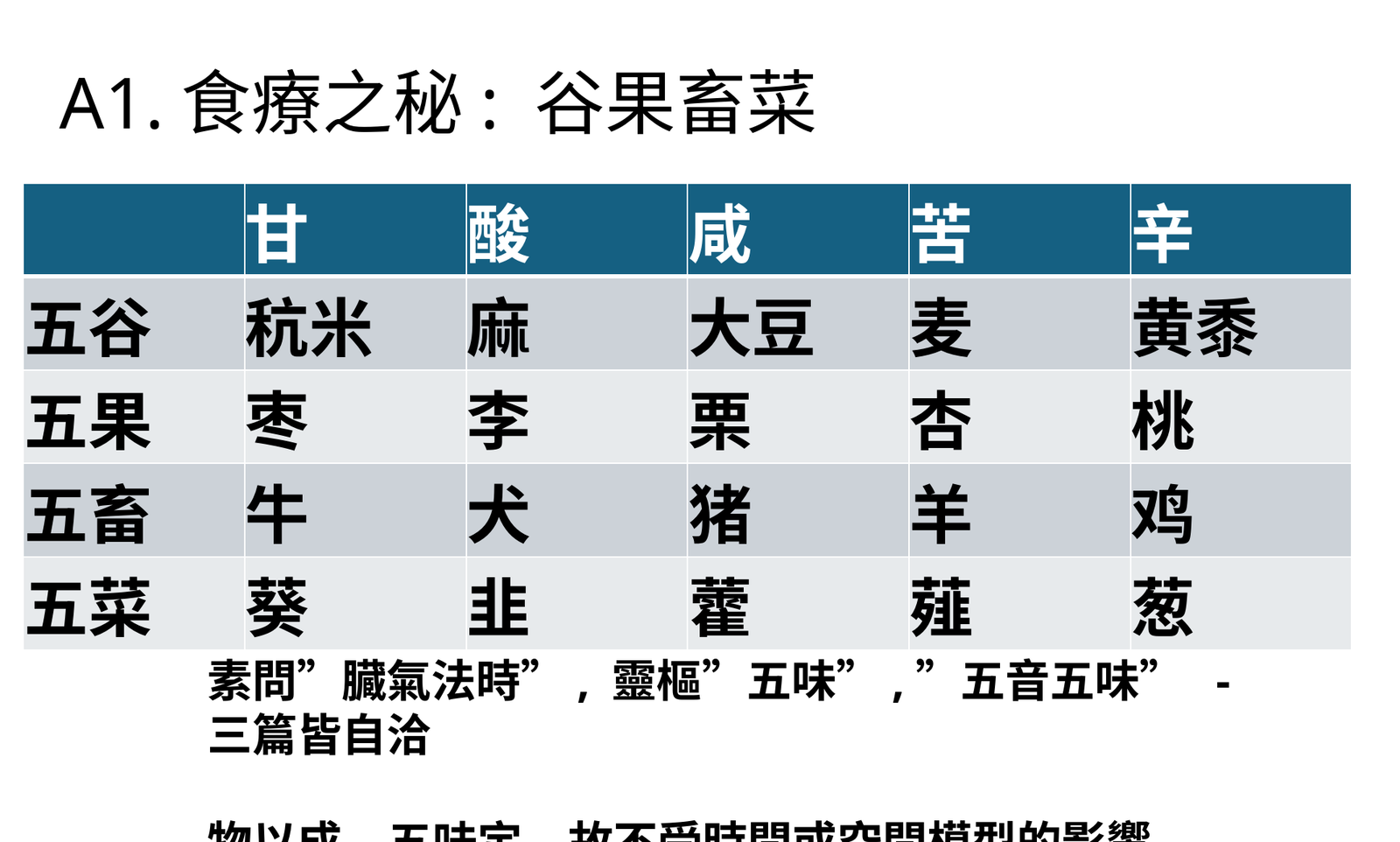
This sixteen-character core rule appears self-consistently in three key chapters of the Huangdi Neijing: “Discourse on How the Qi of the Zang Conforms to the Seasons” in the Suwen, “The Five Flavors” in the Lingshu, and “The Five Tones and Five Flavors” in the Lingshu. Across these different contexts, the correspondences between these twenty basic food items and the five flavors are completely consistent. In theory, the lost classics may once have contained a “fifth” major food category that would perfectly fill a 25-cell matrix. This leaves a valuable clue for future interdisciplinary textual investigation.