

The Five-Distress Temporal Intervention Model of Relaxing, Urgency, Gathering, and Dispersing
Within the temporal model, in addition to the central “supplementing position” and “draining position,” the ancients established a special system-level intervention mechanism for more complex acute pathological states. This is the Five-Distress temporal intervention model, based on physiological properties such as relaxing, urgency, gathering, and dispersing. The model is designed to capture problems that arise in the five zang when they are acutely attacked by pathogenic influences of celestial timing and to provide the fastest relief.
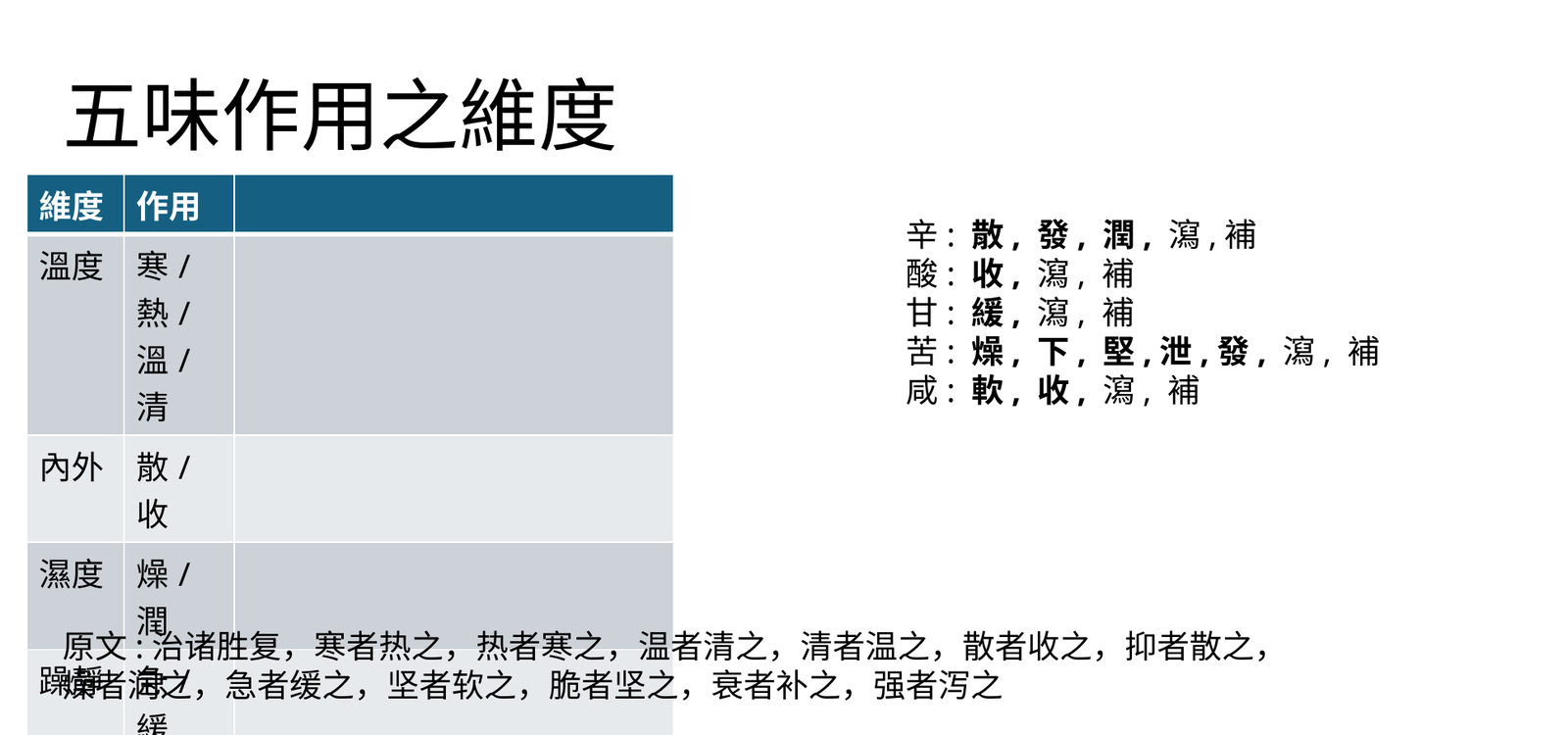
The original wording of the “Discourse on How the Qi of the Zang Conforms to the Seasons” is extremely concise: “When the Liver suffers from urgency, urgently eat sweet to relax it … when the Heart suffers from laxity, urgently eat sour to gather it.” Intervention functions such as “urgently eat sweet to relax it” and “urgently eat sour to gather it” are presented here as the highest first-principle source of many later highly effective formulas—for example, Zhang Zhongjing’s use of Peony and Licorice Decoction, in which sweet and sour combine, to rapidly relieve muscular spasm and abdominal pain. This is taken to show that the ancients’ command of the physical properties of flavors had reached the level of advanced dynamic-systems engineering.