

Six Qi × Seven Major Families of Motion
Within the “Great Treatise on the Utmost Truth,” forty-two formula-composition rules involving the Six Qi have been preserved. They describe how the Six Qi take on different dynamic roles after entering the spacetime of Heaven and Earth.
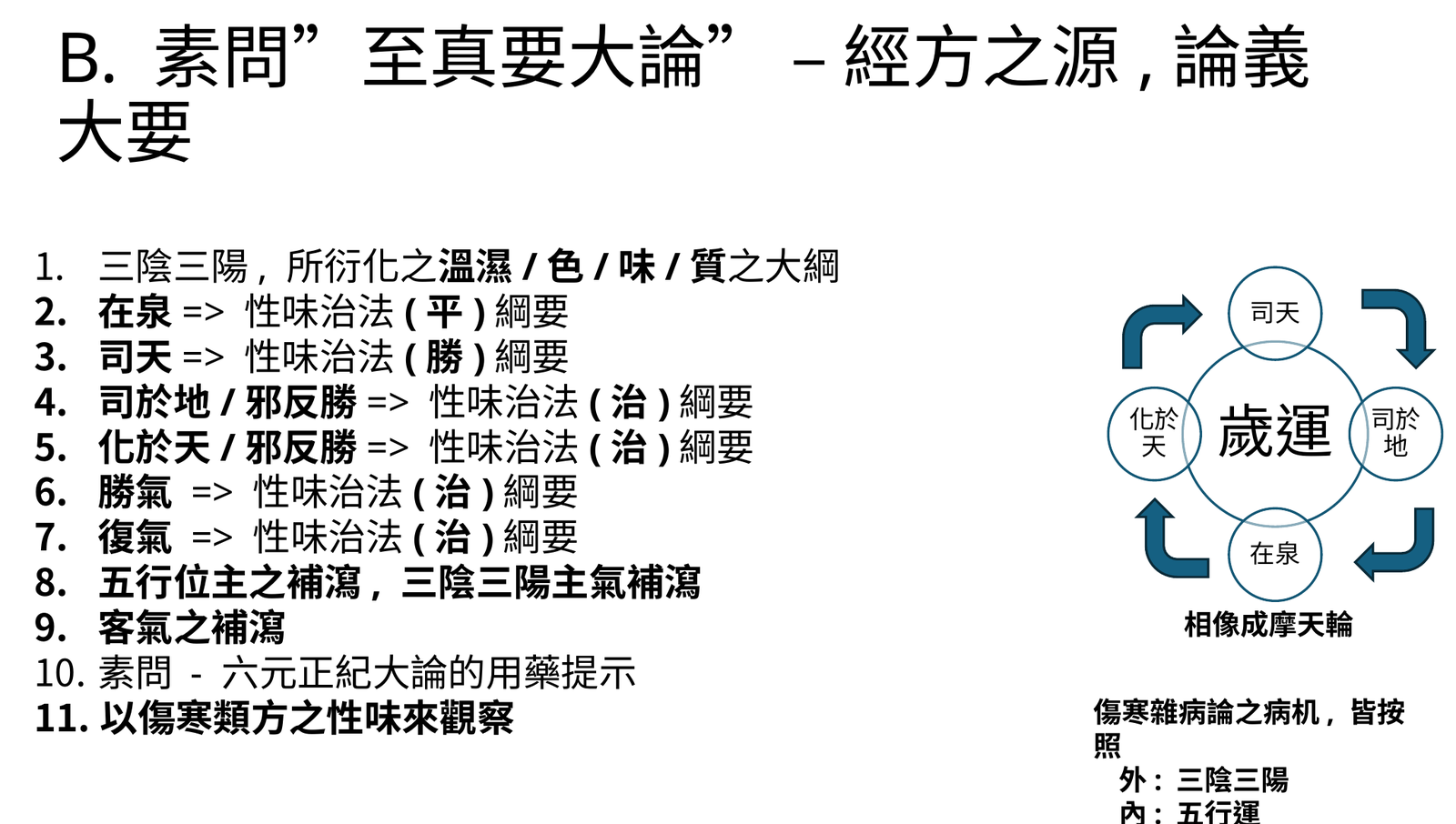
The same qi may at one time govern from above, in which case it is called Sitian; at another time it may respond from below, in which case it is called Zaiquan; or it may occupy an intermediate step on the left or right, producing deflection and flanking pressure, in which case it is called intervening qi. In addition, when one qi becomes excessively strong and suppresses another, it becomes a victorious qi; when the suppressed side rebounds later, it becomes a restorative qi. If a qi that should normally remain settled in its position is instead overcome in reverse by its counterpart, abnormal patterns such as pathogenic qi counter-victory or pathogenic victory over Sitian arise.
The Six Qi are therefore not static nouns. They form a dynamic system of position, direction, host and guest, relative strength, and rebound.
In modern language, the “Great Treatise on the Utmost Truth” is saying that the same natural forces can produce completely different qi-transformation consequences depending on where they stand, which side gains dominance, and what opponent they encounter.
Several dynamic roles of the Six Qi
Section titled “Several dynamic roles of the Six Qi”| Name | Core meaning | Motion characteristic | Everyday analogy |
|---|---|---|---|
| Sitian | The qi governing from above in a given year | Exerts influence from above downward; governs the first half of the year and the heavenly-position pattern | Like the atmospheric system pressing over a city for the year |
| Zaiquan | The qi responding from below in a given year | Accumulates and receives from below; influences the second half of the year and the earthly-position pattern | Like earthly qi accumulated from soil, groundwater, and geothermal heat |
| Intervening qi | Qi located on the left, right, or intermediate steps | Flanks, deflects, or adds momentum so that the principal qi no longer travels in a simple straight line | Like two crosswinds pushing an airflow off course |
| Victorious qi | One qi temporarily becomes excessive and suppresses another | One-way suppression prevents the defeated qi from functioning normally | Like a season suddenly dominated by one exceptionally strong air mass |
| Restorative qi | The suppressed qi rebounds later | Rebound, retaliation, or return, often following victorious qi | Like a spring suddenly rebounding after being compressed for a long time |
| Pathogenic qi counter-victory | Qi that should be settled below is overcome in reverse by another qi | The lower position loses stability and earthly qi is disturbed in reverse | Like land that should be moist being dried instead by hot air |
| Pathogenic victory over Sitian | Qi that should be settled above is overcome in reverse | The upper position loses stability and the weather pattern is disturbed in reverse | Like a generally hot annual pattern suddenly capped by a powerful cold air mass |
| Guest–host victory and restoration | The contest between guest qi and host qi | Incoming guest qi overcomes the normal position, or the local normal qi counters the incoming climate | Like an imported climate overwhelming the local norm, or the local climate forcefully resisting it |
These names look complicated, but they all answer the same set of questions:
- Where is this qi positioned?
- Is it in the host position or the guest position?
- Is it operating normally, or has it become excessive and suppressive?
- If it has been suppressed, will it rebound?
- Is it following celestial timing, or disrupting the original pattern in reverse?
Thus, when reading the “Great Treatise on the Utmost Truth,” these terms should be understood as different roles within the motion of the Six Qi.
“Sitian, Zaiquan, and intervening qi” mainly describe position and host–guest relations. “Victorious qi and restorative qi” mainly describe strength and rebound. “Pathogenic qi counter-victory, pathogenic victory over Sitian, and guest–host victory and restoration” mainly describe abnormal interference and pattern imbalance.
This is precisely what is most important about the Five Movements and Six Qi: the system does not merely tell us which qi belongs to a given year. It further explains how these qi are positioned above and below, flank one another from the sides, suppress one another, and rebound against one another, ultimately forming the qi-transformation background of an entire year.