

The Treatment Structure of the Six Qi in Zaiquan Excessively Invading the Interior
Formal logical testing of the “Great Treatise on the Utmost Truth” rules for “the various qi in Zaiquan, with the six excesses invading the interior” yields an important result: the first therapeutic flavor for qi in Zaiquan follows a simple Five-Phase overcoming model more closely than the Sitian rules do. Only the dampness cell needs the special rule of “bitter drying” to override the Five-Phase default.
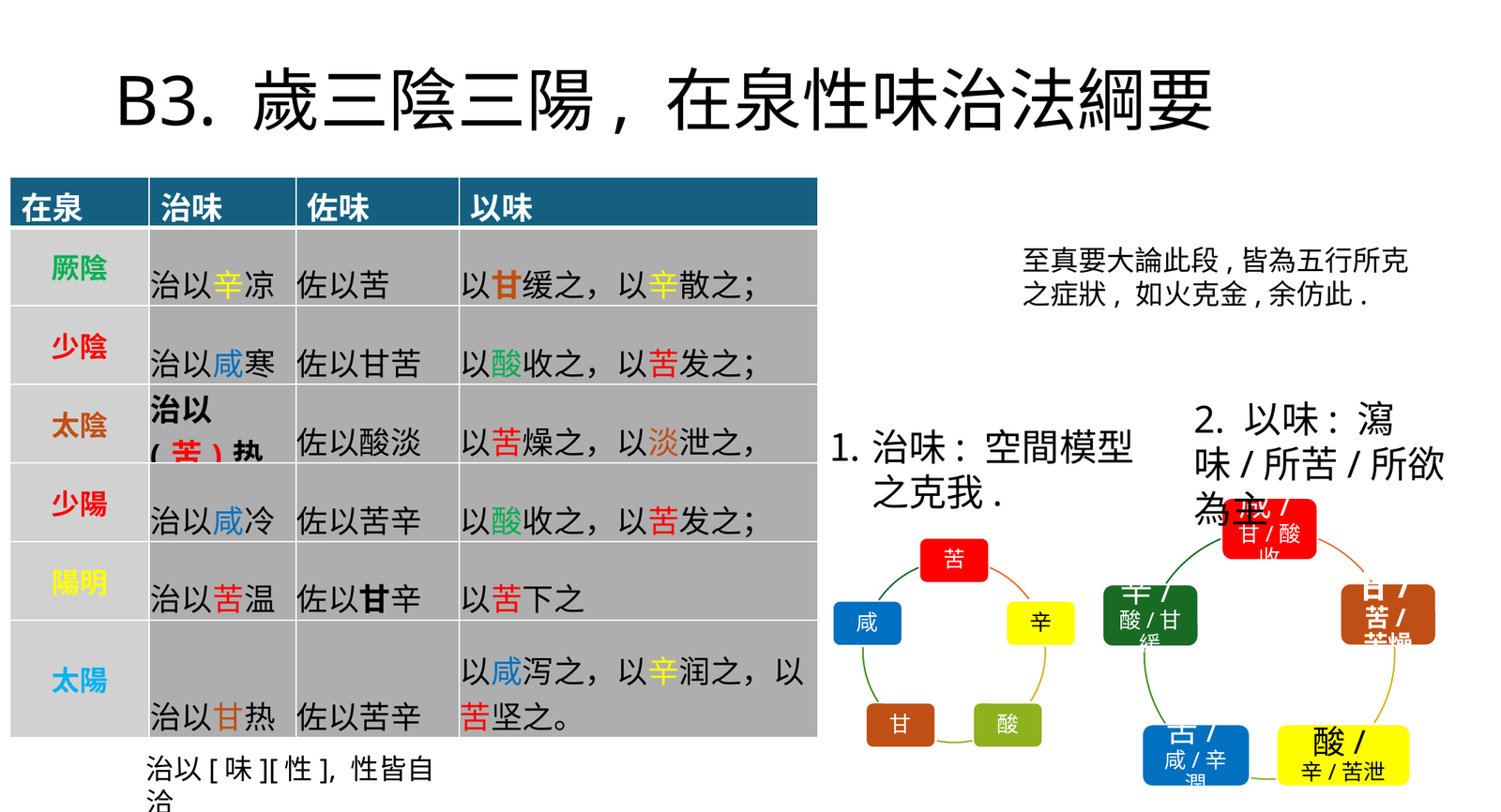
When the Six Qi are in Zaiquan, the pathomechanistic emphasis lies more on imbalance in the interior, lower position, earthly qi, and deeper zang-fu layers. The first therapeutic flavor therefore usually takes the intrinsic flavor of the phase that overcomes the phase of the excessive qi: excessive Wind-Wood is leveled with the Metal flavor pungent; excessive Heat-Fire and Ministerial Fire with the Water flavor salty; excessive Dryness-Metal with the Fire flavor bitter; and excessive Cold-Water with the Earth flavor sweet. Formal results show that five of the six Zaiquan cells—wind, heat, fire, dryness, and cold—follow this Five-Phase overcoming rule.
The only special case is “dampness excessively invading the interior.” Under simple Five-Phase overcoming, Damp-Earth should be controlled by the Wood flavor sour. The text instead says “treat with bitter and hot,” and later directly states “dry it with bitter.” The main contradiction here is therefore not abstract “excess Earth,” but excessive moisture itself. Treatment uses the drying function of bitter rather than Wood overcoming Earth. This shows that the Inner Canon does not apply Five-Phase generation and overcoming rigidly; above that rule, it permits more direct treatment of the property of the qi.
The first therapeutic flavor of the Zaiquan group can therefore be compressed into one sentence: except for dampness, which uses bitter drying, the others mainly choose flavor by Five-Phase overcoming. In outline:
- Wind-Wood → pungent and cool
- Heat-Fire → salty and cold
- Damp-Earth → bitter and hot
- Ministerial Fire → salty and cool
- Dryness-Metal → bitter and warm
- Cold-Water → sweet and hot
This structure is more regular than the Sitian-victory group. Sitian Fire and Sitian Cold shift to sour gathering and pungent dispersal because of upper-position “dispersal” and “cold closure”; in Zaiquan, Fire still uses salty-cool and Cold still uses sweet-hot, suggesting that the Zaiquan level emphasizes internal Five-Phase balancing more than directional correction of upper-level opening, closing, gathering, and dispersal.
The assisting flavors in this Zaiquan group cannot be reduced to a single “second flavor.” Phrases such as “assist with sweet and bitter,” “assist with sour and bland,” and “assist with bitter and pungent” are better treated as assisting-flavor sets rather than a strict sovereign–minister sequence. Formal analysis organizes the full assisting sets as follows: wind uses bitter; heat uses sweet and bitter; dampness uses sour and bland; fire and cold often use bitter and pungent; dryness uses sweet and pungent. Their role is not simply to overcome the pathogen, but to correct directions that the principal flavor has not handled—such as relaxing, gathering, dispersing, protecting fluids, drying dampness, or preventing overcorrection.
The tail rules more closely resemble true functional operators. “Relax it with sweet,” “disperse it with pungent,” “gather it with sour,” “effuse it with bitter,” “dry it with bitter,” “drain it with bland,” “direct it downward with bitter,” “moisten it with pungent,” and “consolidate it with bitter” should not be read as mere third or fourth flavors. They are operational units of flavor × function. In other words, the first therapeutic flavor addresses the main pathomechanism, the assisting flavors form a correction set, and the tail explicitly determines the final qi-transformation direction: relaxing, dispersing, gathering, effusing, drying, draining, descending, moistening, or consolidating.
The final conclusion is that the treatment of “the various qi in Zaiquan, with the six excesses invading the interior” uses Five-Phase overcoming as its main axis, overrides that default with bitter drying for dampness, employs assisting-flavor sets for multi-target correction, and uses tail functional operators to specify the direction of qi transformation. It is not a table of Six-Qi flavors to memorize, but a treatment grammar that can be formalized, compressed, and programmatically tested.