

The Treatment Structure of the Victory of the Six Qi
The “Great Treatise on the Utmost Truth” passages on the victory of the Six Qi discuss how the first flavor, assisting flavors, and later draining flavors are arranged when one qi becomes excessive, gains the advantage, and suppresses the side it overcomes. Formal testing yields a central conclusion: the first therapeutic flavor in “victory of the root qi” does not directly drain the victorious qi itself. It first locates the side that has been suppressed by that qi.
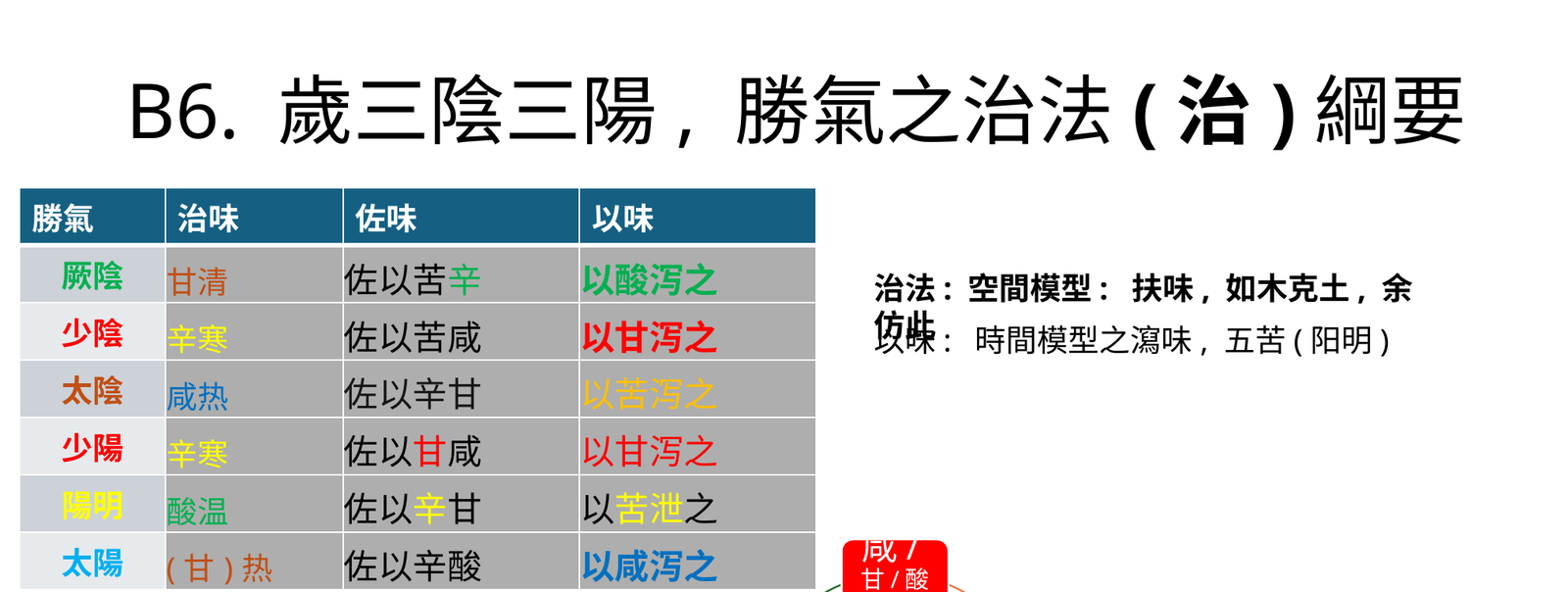
Thus, when Jueyin Wind-Wood is victorious, Wood overcomes Earth, so the first flavor is Earth’s intrinsic flavor, sweet. When Shaoyin Heat-Fire or Shaoyang Ministerial Fire is victorious, Fire overcomes Metal, so the first flavor is Metal’s intrinsic flavor, pungent. When Taiyin Damp-Earth is victorious, Earth overcomes Water, so the first flavor is Water’s intrinsic flavor, salty. When Yangming Dryness-Metal is victorious, Metal overcomes Wood, so the first flavor is Wood’s intrinsic flavor, sour. The phrases “treat with sweet and clear/cool,” “pungent and cold,” “salty and hot,” and “sour and warm” are therefore not arbitrary combinations. When one of the Six Qi is excessive, treatment first focuses on the suppressed side that has been forced away from its normal state.
This rule cannot simply be called “supplement the side that is overcome.” The flavor used here is the zang-image intrinsic flavor, not the supplementing flavor in the standard Five-Phase supplementation/drainage table. Metal’s intrinsic flavor is pungent, for example, while in the supplementation/drainage table pungent is instead the draining flavor of Metal. More precisely, the first therapeutic flavor marks the suppressed side rather than simply supplementing it.
The sole exception is “when Taiyang is victorious, treat with sweet and hot.” Under the general rule, victorious Taiyang Cold-Water overcomes Fire, so one would expect Fire’s intrinsic flavor bitter. The text instead uses sweet-hot. Here the therapeutic emphasis shifts toward powerful direct correction of Cold-Water itself: sweet belongs to Earth and can directly control Water; sweet can also relax the constriction and rigidity of cold coagulation; and the hot thermal property directly opposes Cold. Taiyang Cold victory therefore does not first locate the suppressed side, but uses sweet-hot to directly address excessive Cold-Water, closure, and constriction.
The first-flavor rule can therefore be compressed as follows:
General victory of the Six Qi: victorious qi becomes excessive → first therapeutic flavor = intrinsic zang-image flavor of the side it overcomes and suppresses → later use a draining flavor to address the victorious qi itself
Taiyang Cold victory: excessive Cold-Water → sweet-hot → Earth controls Water; sweet relaxes cold coagulation; hot opposes Cold
The later phrases “drain it with sour,” “drain it with sweet,” “drain it with bitter,” “discharge it with bitter,” and “drain it with salty” more clearly approach subsequent treatment of the victorious qi itself. The first flavor therefore does not immediately eliminate the victorious qi; it first settles the pressured side. The tail draining/discharging operation then explicitly reduces the excess of the victorious qi. This gives Six-Qi victory a two-layer structure: first locate the defeated side, then treat excess of the victorious qi.
The assisting combinations—“assist with bitter and pungent,” “bitter and salty,” “pungent and sweet,” “sweet and salty,” “pungent and sweet,” and “pungent and sour”—should not be split into fixed second and third flavors, but treated as correction sets. They fill directions not handled by the first flavor, including discharge and descent, dispersal, relaxation, thermal balance, dryness/dampness, and prevention of overcorrection. Formal testing likewise indicates that the assisting layer cannot be fully governed by one formula and must preserve the influence of treatment class and Six-Qi position.
The true value of these passages is therefore not memorizing “Jueyin–sweet, Shaoyin–pungent, Taiyin–salty, Shaoyang–pungent, Yangming–sour, Taiyang–sweet,” but seeing the logic by which the Inner Canon handles victorious qi: when a qi is excessive, treatment first cares for the side being overcome, then reduces the victorious qi through later draining/discharging operators. Only Taiyang Cold victory, because its coagulating and closing force is especially strong, shifts to sweet-hot to control Water and relax Cold directly. The result is a qi-transformation treatment grammar that can be formally compressed rather than merely memorized as an empirical table.