

AI-Assisted Extraction of Causal Reasoning from Ancient Texts
We repeatedly demonstrate how AI can assist in organizing ancient materia-medica texts, but the point is not to let AI replace the physician. Its role is to help extract the causal reasoning of the ancients. For materia medica, the most important question is not “what does this drug treat?” but “on what basis did the author infer that it could treat this?”
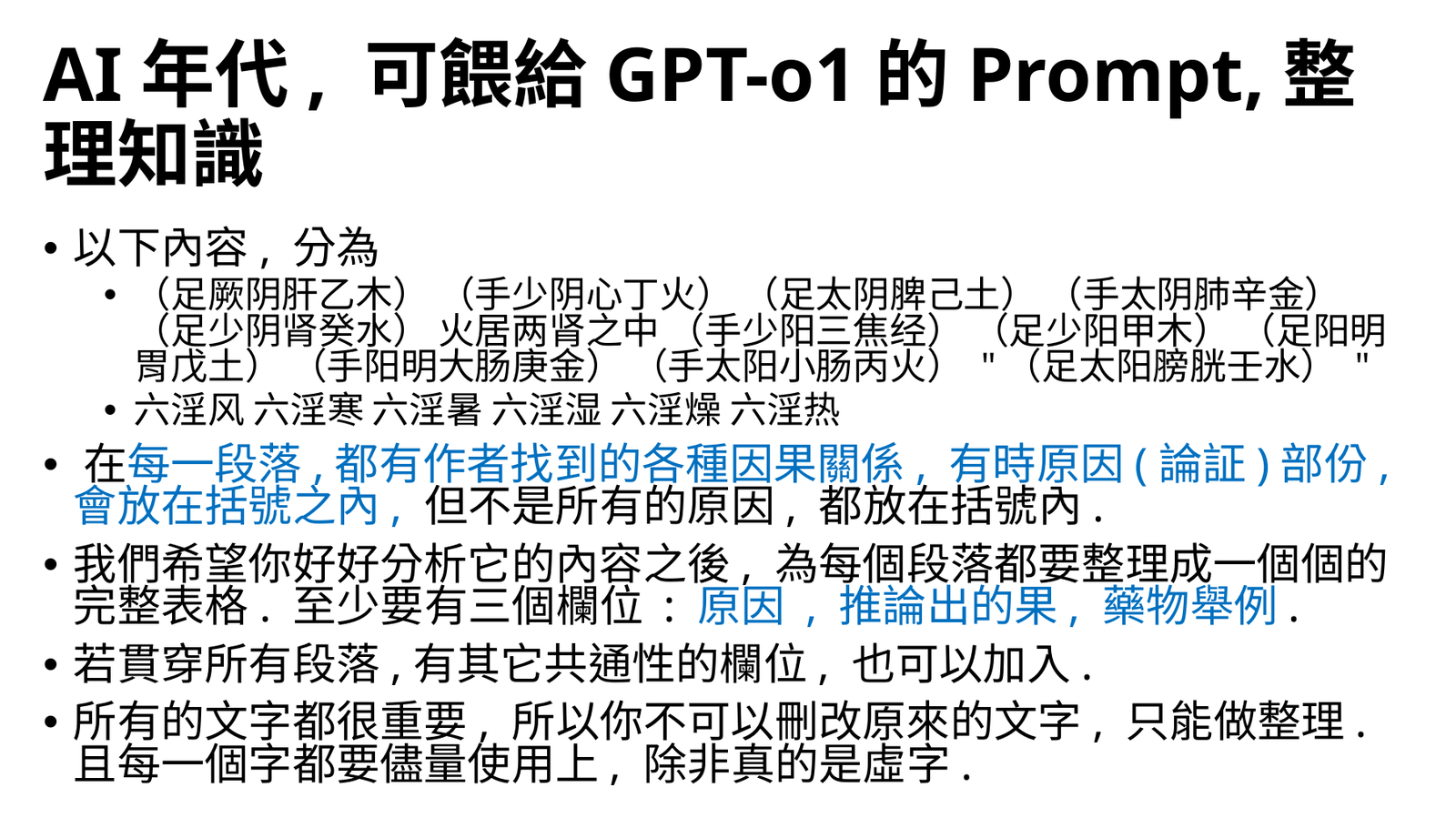
A basic method of causal extraction is to split a passage into three columns: cause, inferred result, and drug example. Causes are often hidden in parentheses, annotations, or classical quotations; results appear as functions, indications, or symptoms. AI’s task is to turn the reasoning chain embedded in continuous prose into visible arrows that can be reviewed.
Interested readers can try instructing an assistant to read Bencao Qiuzhen, extract the causes and results from each section, and output a table. This method helps modern learners quickly see Huang Gongxiu’s reasoning: which inferences come from zang-fu, which from the six excesses, and which are only pathological labels.