

Validating a Classification Framework for the Principles of Materia Medica
We take the general principles of materia medica represented by the Qiantang school’s Theory of Medicinal Nature, Form, and Name as a framework and test it against Xu Lingtai’s reasoning. This is a form of cross-physician validation: can one physician’s classification framework contain the causal reasoning of another?
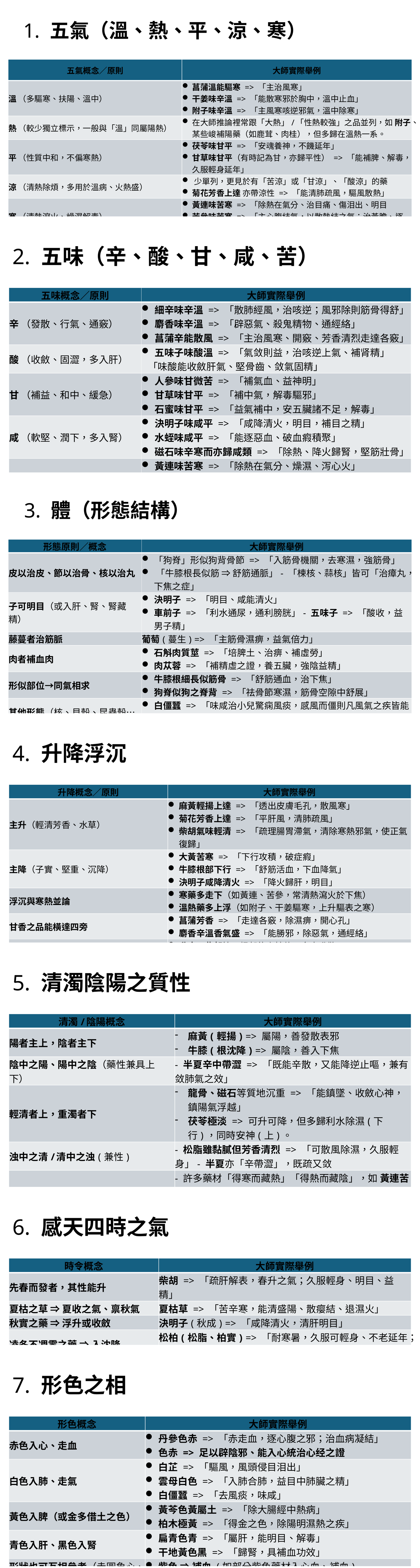
The framework includes dimensions such as the five qi, five flavors, bodily form, ascent/descent/floating/sinking, clarity/turbidity, receiving the qi of the four seasons of Heaven and Earth, form and color, function, and naming. If Xu Lingtai’s explanations of medicinal effects can be effectively classified into these dimensions, the framework demonstrates strong summarizing power.
We show several classification results. The five qi are relatively easy because most medicines in the Shennong Bencao Jing are assigned a thermal nature. The five flavors can explain pungent dispersal in Shichangpu and bitter-cold action in Huanglian; bodily form can explain vines, seeds, bark, and kernels; clarity/turbidity can explain the rapid action of aromatic drugs and the sinking-settling quality of mineral drugs.