

The Central-Earth Spatial Model of the Five Flavors and the Affinities of the Five Entrances
To understand the regularities of the five flavors of medicines and foods, two independent models must be distinguished.
The first is the Central-Earth spatial model of the five flavors. In this spatial dimension, the Five Phases are distributed according to geometric topology, with “Earth occupying the center” as the core hub. At the same time, this model defines the rule of Five-Entrance affinity after the five flavors enter the body—for example, sour enters the Liver and bitter enters the Heart.
Five-Entrance affinity only indicates a channel tendency during the absorption of a medicinal substance. It absolutely does not mean that the five flavors have the same supplementing or draining effects on the five zang organs.
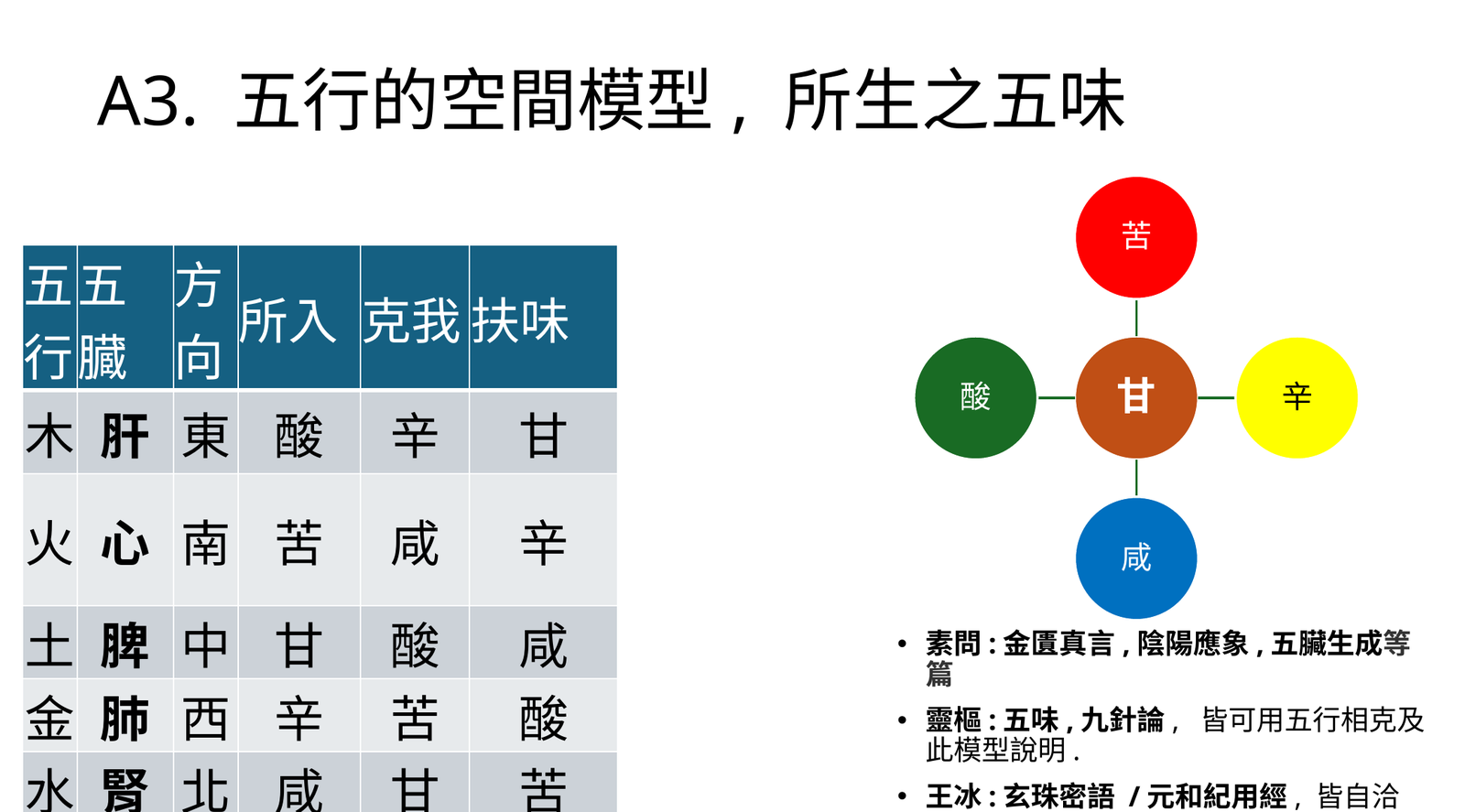
The spatial model is fundamentally governed by earthly qi and the physical spatial structure of matter. Once things carrying the five flavors—sour, bitter, sweet, pungent, and salty—enter the black box of the human body, different internal organs, because of their own distinctive spatial-energy grids, develop an “affinity” for particular flavors comparable to affinity in modern chemistry.
Classical formulations of the spatial five-flavor model are widely distributed through the Huangdi Neijing, including “Discourse on the True Words of the Golden Chamber,” “Great Treatise on the Correspondences and Manifestations of Yin and Yang,” and “Discourse on the Generation of the Five Zang.” They appear in neatly parallel Five-Phase passages such as “the East generates wind … among tones it is jue; among flavors it is sour.” The Tang scholar Wang Bing also gave detailed annotations on this in the Xuanzhu Miyu and Yuanhe Jiyong Jing.