

The Five Desires of the Five Zang and the Temporal Model's Rules of Supplementation and Drainage
At the core of the “Discourse on How the Qi of the Zang Conforms to the Seasons,” the most striking and counterintuitive feature is its temporal model of supplementation and drainage. The rule first defines the special physiological tendencies sought by the five zang in particular temporal phases, called the five desires—for example, “the Liver desires dispersal” and “the Heart desires softness.” From these desires, the ancients derived a set of supplementation-and-drainage formulas completely different from the spatial model—for example, for the Liver, pungent supplements while sour drains. This is presented here as the ultimate first principle by which classical formulas can precisely mobilize internal qi dynamics.
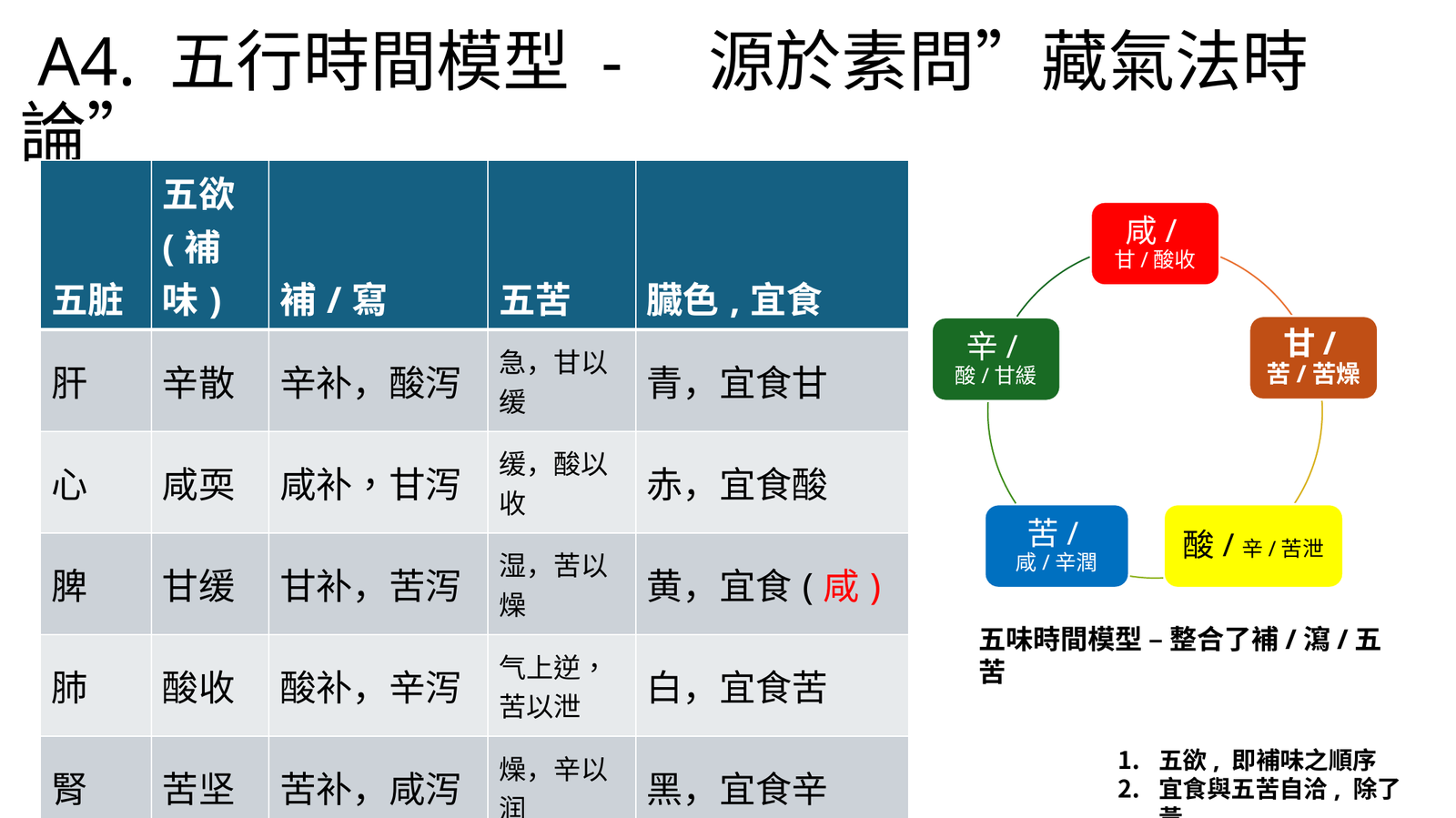
Five desires and the supplementing position: When an organ—for example Liver-Wood—needs to diffuse and disperse in a particular temporal phase (“desires dispersal”), it must be given a flavor that follows the direction of its oscillation—such as pungent flavor, which promotes dispersal—to “supplement” it. Thus, in the temporal model, pungent flavor becomes the supplementing position of Wood.
Draining position: When excessive energy must be restrained, a flavor that opposes the organ’s physiological tendency is used—for example, sour flavor is astringent and therefore counters dispersal—to “drain” it. Sour flavor thus becomes the draining position of Wood. This is completely opposite to, and orthogonal with, the spatial model’s affinity pattern in which sour enters the Liver and pungent overcomes Wood.