

The Treatment Structure of the Six Qi as Guest Qi
The “Great Treatise on the Utmost Truth” passages on the Six Qi as guest qi concern neither a qi that has already become victorious nor the compensatory restoration that follows victory. They concern how supplementation, drainage, and later functional operations are arranged when the Six Qi descend upon host positions specifically in the role of guest qi. Formal testing yields a strikingly clean conclusion: in each “guest qi” line, the flavor listed first is precisely the flavor that supplements the guest qi itself, while the flavor listed second is precisely the flavor that drains the guest qi itself.
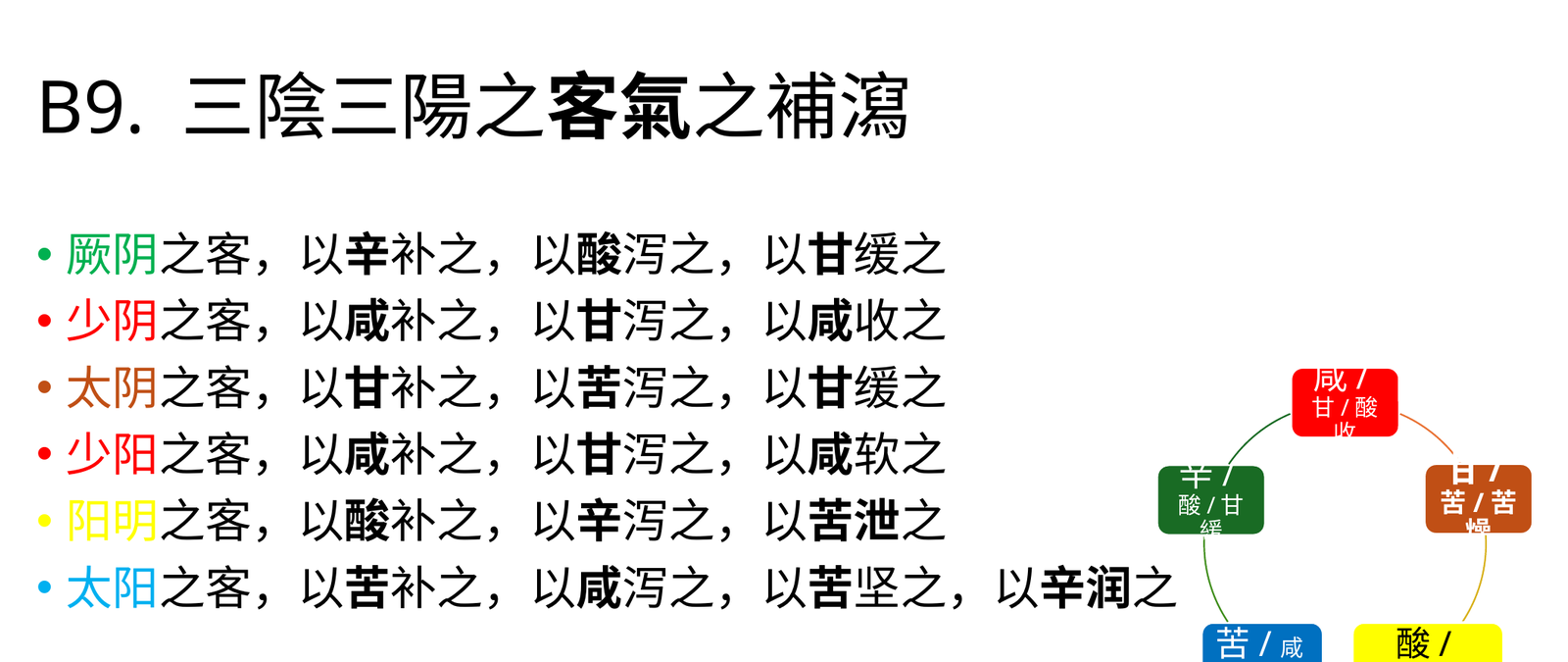
Thus, Jueyin Wood as guest uses pungent to supplement and sour to drain; Shaoyin Fire uses salty to supplement and sweet to drain; Taiyin Earth uses sweet to supplement and bitter to drain; Shaoyang Fire is the same as Shaoyin, using salty to supplement and sweet to drain; Yangming Metal uses sour to supplement and pungent to drain; Taiyang Water uses bitter to supplement and salty to drain. All six sets match the standard Five-Phase supplementation/drainage flavor table, giving 6/6 in programmatic verification.
A line such as “For Jueyin as guest, supplement it with pungent and drain it with sour” should therefore not be read as meaning pungent is always the sovereign flavor and sour always the minister. It functions more like a supplementation/drainage dictionary for guest qi. When the guest qi is deficient or suppressed by the host qi, its supplementing flavor may be used; when the guest qi is excessive and suppresses the host position, its draining flavor is used instead. The real clinical judgment must still begin by assessing host–guest victory and defeat. One should not supplement the guest unconditionally merely because the text says “supplement it with pungent.”
This is also the most important difference between the “Six Qi as guest” and the ordinary “victory” and “restoration” groups. Ordinary victory/restoration follows the compensatory logic “where there is victory, there is restoration.” Host and guest, however, are governed by a separate framework: “victory without restoration,” “host victory is contrary, guest victory is compliant,” “break down what is excessive and supplement what is insufficient; one must settle host and guest.” Host–guest victory therefore cannot simply be inserted into the ordinary victory/restoration model.
The most concise structure is:
Six Qi as guest: guest qi descends upon the host position → first listed flavor = flavor that supplements the guest qi → second listed flavor = flavor that drains the guest qi → actual supplementation or drainage depends on whether host or guest is victorious
Guest victorious: drain guest + supplement host
Host victorious: drain host + supplement guest
Host and guest balanced: no additional intervention solely because of the host–guest relationship
Later phrases such as “relax it with sweet,” “gather it with salty,” “soften it with salty,” “discharge it with bitter,” and “consolidate it with bitter and moisten it with pungent” belong to tail functional operators rather than ordinary third and fourth flavors. After supplementation/drainage of the guest qi, they further specify the direction of qi transformation: sweet relaxes, salty gathers, salty softens, bitter discharges, bitter consolidates, and pungent moistens. The Taiyang guest-qi line even explains that this is to “open and effuse the interstices, bring the fluids through, and circulate qi,” showing that bitter consolidation and pungent moistening are not abstract flavor pairings but operations intended to reopen the interstices and restore circulation of fluids and qi.
The real value of this group is therefore not memorizing “Jueyin pungent/sour, Shaoyin salty/sweet, Taiyin sweet/bitter, Shaoyang salty/sweet, Yangming sour/pungent, Taiyang bitter/salty.” It is recognizing the Inner Canon’s handling of guest qi: first establish a dictionary of the guest qi’s own supplementing and draining flavors, then choose supplementation or drainage according to host–guest victory and defeat, and finally complete concrete qi-transformation operations such as relaxing, gathering, softening, discharging, consolidating, and moistening through tail operators. This makes the guest-qi passages a clear and computable grammar for balancing host and guest rather than a scattered table of flavor experience.